About
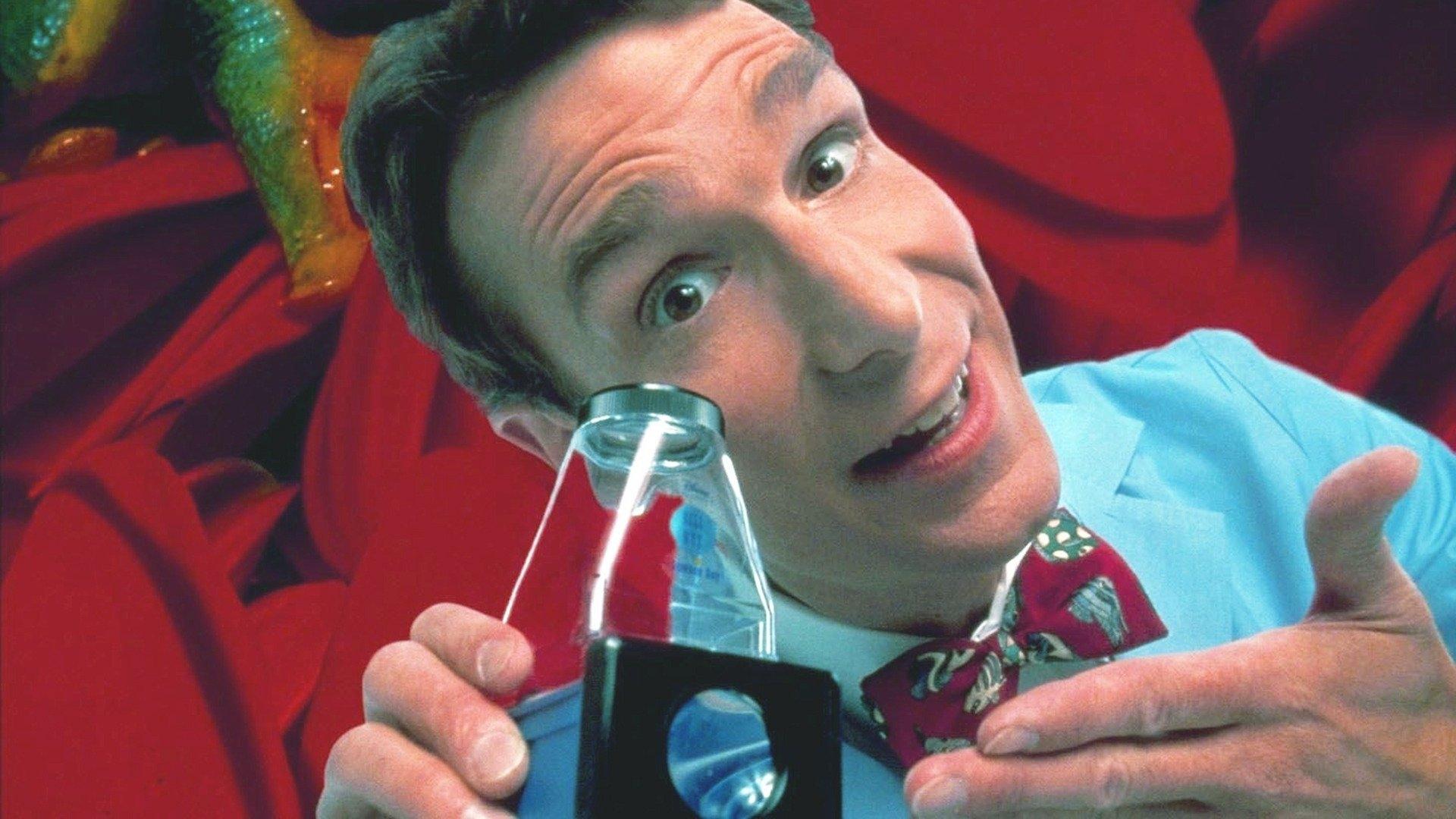
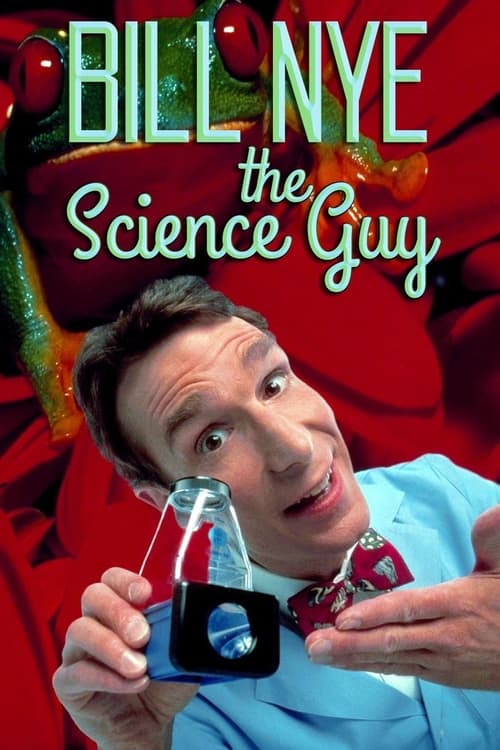
It's "Mr. Wizard" for a different decade. Bill Nye is the Science Guy, a host who's hooked on experimenting and explaining. Picking one topic per show (like the human heart or electricity), Nye gets creative with teaching kids and adults alike the nuances of science.
Cast
Bill Nye
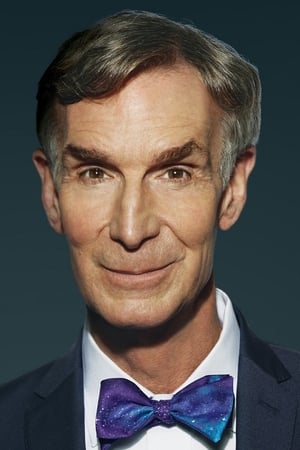
as Self - Host
Rachel Glenn
as Nancy
Jennifer Lin
as
Amy Broder
as Amy
Ethan Ferkiss
as Smell Gibson
Episodes
Season 1
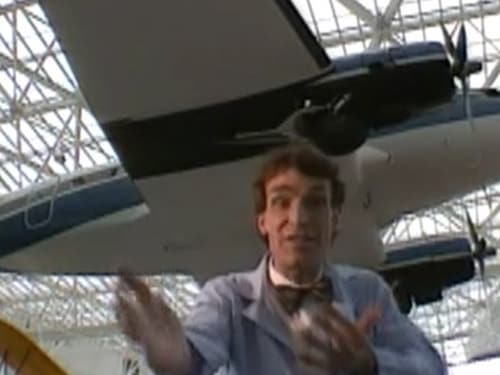
Flight
Things that fly need air. Even though we walk through it, breathe it, and sneeze it, air seems to be a whole bunch of nothing. But air is there, and it's powerful. Balloons inflate because air presses on the insides and outsides of the balloon. Air pressure in tires supports the weight of bikes, buses, trucks, cars, and planes. But air doesn't need to be inside something to exert pressure. Air that moves around pushes, too. What do birds, planes, kites, Frisbees, and helicopters have in common? They fly because moving air creates lift, or a push up. Airplane wings are shaped to push air down. The momentum of the air going down pushes wings up. Air above the wing gets going faster than the air underneath. Fast-moving air zips along, without pushing as hard side to side or up and down. The slow air pushes up from below harder than the fast air pushes down from above ... and you're airborne! Every flying thing, from the tiniest flying insect to the biggest airplane, us

Earth's Crust
Don't just go with the flow. Settle down on the crust. Imagine a world without any crust. There would be no pies, just goopy filling, no bread, no hamburger buns, and no you or me. That's right. You, and every living thing we know of, live on or in the Earth's crust. And, living things need the Earth's crust to survive. Let's look at the science of the surface. By carefully studying the Earth's surface, scientists have discovered that the Earth is made up of gigantic layers. At the center of the Earth, there is a core – a big ball of solid metal mostly iron. The core is surrounded by a layer of liquid iron and other minerals. We usually just call it the outer core. The next layer, around the outer core is called the mantle. You may have seen a mantle above a fireplace. Well, the mantle is above the Earth's hot core places. The mantle is gooey hot nearly melted rock that flows the way asphalt does on a hot summer day. Scientists often say that the mantle is plastic. It
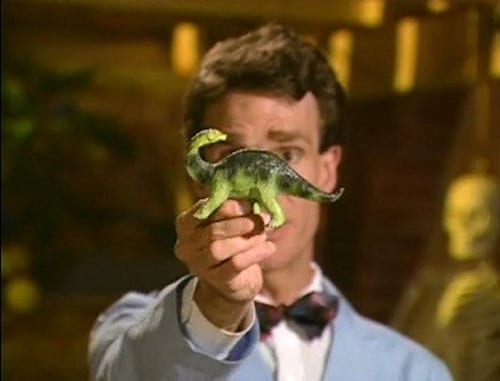
Dinosaurs
We can dish the real dirt about dinosaurs, thanks to fossils - traces of theses astonishing animals. Dinosaurs did not print newspapers. They did not take family snapshots or videos 65 million years ago. The only proof scientists have of dinosaurs is their fossils, especially bones. They would never have survived billions of years waiting for some human to trip over them. Luckily for paleontologists (scientists who study the past), now and then dinosaurs died, and their bones were covered by mud, or sand. As the bones sat protected from weather, they absorbed minerals from the soil around them. The minerals chemically worked their way into the bones. Millions of years later, we can find them and dig them up. Humans were not around to see what actually killed the ancient dinosaurs. Many scientists think a meteorite, or lots of meteorites, crashed into the Earth. When the space rocks hit the ground, they made big craters and kicked up a lot of dust and dirt. If enough d
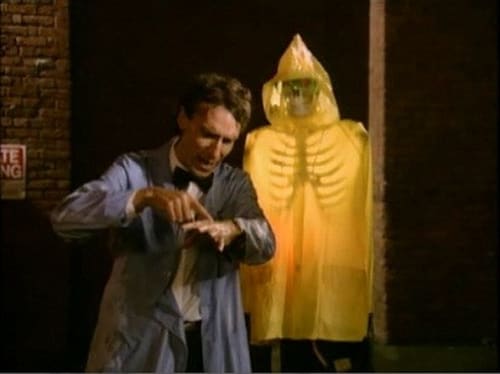
Skin
Learning about skin science is no sweat. It's gigantic. It's gargantuan. It's your skin. It's your body's biggest organ. If you could lay your skin out flat, it would cover about one and a half square meters. Your skin stops you from drying out, protects you from the weather, and keeps bacteria and viruses from getting inside your body. Your skin is also your personal air conditioner and heater all in one. Sweating cools you off. When you're hot, glands in your skin push a mixture of water and other chemicals onto the surface of your skin. When the water evaporates, it takes some of the heat with it, and you're cooler. When you're too cold, your skin muscles start twitching. Shivering makes your body warm up. Without skin, you wouldn't be able to feel the difference between a sheet of paper and a wool blanket. There are thousands of touch receptors inside skin. When you touch the remote control, the receptors send information about the remote's temperature, thicknes
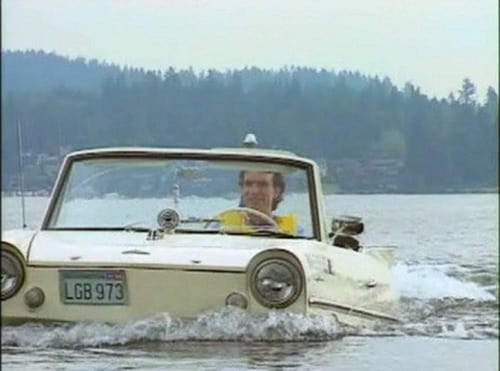
Buoyancy
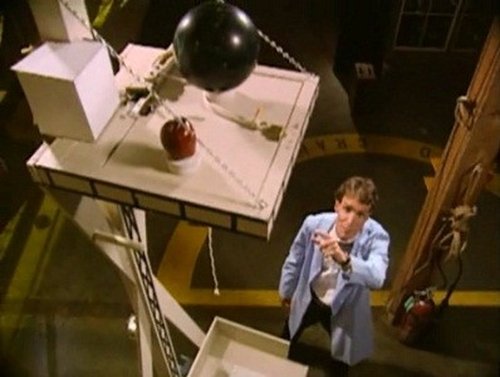
A hot-air balln ride and a trip to the aquarium help Bill Nye explain why things float
Gravity
Next time you throw a ball in the air, and it doesn't fly off into outer space, thank gravity. Right now, you and everything in the room where you are, is getting pulled down by gravity. If you don't believe it, push a book of your desk. It will go plummeting toward the center of the Earth. It's gravity. The Earth's mass, the stuff it's made of, creates gravity. It's pulling down on you and every other object you can see; it's even pulling down on the air and the ocean. Not only that, you and every atom of every thing around you has gravity. So, the objects and atoms are all, ever so slightly, pulling up on the Earth! Without gravity, there would be no weight. When you step on a bathroom scale, the scale is getting squeezed between you and the Earth. The scale measures how strong this mutual attraction is. Gravity makes a force that pulls objects together. Not only is gravity pulling on every atom and molecule of everything around us, it pulls over huge, gigantic di
Digestion
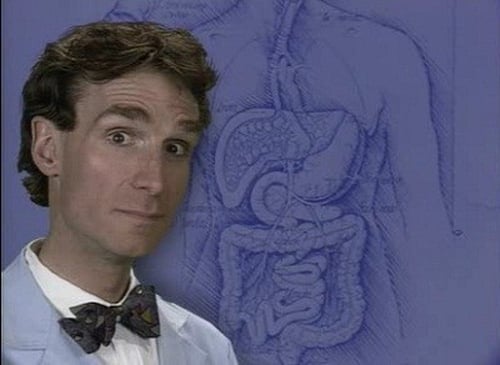
Take time to digest this show. They say that your food is no more inside you than a pencil is inside a donut, when it's poked through the hole. Instead of the food going in you, food goes through you. But, all the energy you get to live and grow comes from your food. All the chemicals that become your body and brain as you get bigger, come from your food. You get these vital chemicals through a process called ""digestion."" Your body breaks food down and grabs all the nutrients you need from it. Then, your body gets rid of what's left over. Digestion starts in your mouth. You begin breaking food down by breaking it into pieces with your teeth and jaw muscles. Your saliva (your spit) is full of chemicals that react with the chemicals in food and make them break apart. Then you swallow. Your food goes down a tube (your esophagus) to your stomach, where powerful hydrochloric acid breaks it down further into a mushy mash we call chime (kime). From there, the chime goes in
Phases of Matter
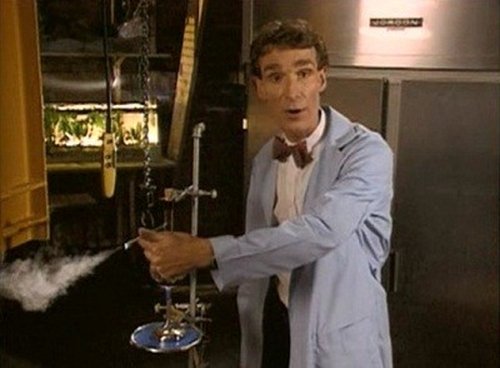
Bill Nye is going through a phase - a phase of matter. Check out the ""Phases of Matter"" episode to find out about rock-solid solids, liquidy liquids, and gassy gases. It's phase-tastic! Everything around us is made of stuff called matter, and all matter is made of atoms. Matter is anything that comes in three varieties, what scientists call phases. There are solids like rocks, cookies, and desks. There are liquids like water, honey, and juice. And there are gases, we breathe air and the helium in balloons. The main difference between the three phases is how fast the matter's atoms move. All atoms move around because they have energy. The more energy that's in something, the faster the atoms move. Atoms in an ice cube don't move very much - they're frozen in place. The atoms in liquid water slip and slide around - that's why you can pour it and spill it. Water vapor atoms are moving pretty fast - that's why they float around in air (a mixture of other gasses). Changing
Similar Shows
Shows like this one












Recommended for You
Based on this series